Why outfit descriptions keep coming out wrong
When writing a costume prompt, most people reach for one overall impression: “wearing a vintage-style dress”. The model receives very little information that way — which decade, which fabric, which length, what neckline, whether there is a pattern — all of it is left to guesswork. Guess wrong once and you redraw ten times.
Split the outfit into four layers and the hit rate improves noticeably. The split also lines up with the tag system in the costume library.
Layer one: colour
Colour is the first thing the model picks up, and the easiest to write vaguely. “Beige” might be cream, oatmeal or light camel. The safer move is to anchor to a specific colour family:
ivory whiteis more precise thanwhiteburgundyis more precise thanredforest greenis more precise thangreen
If there is a main and a secondary colour, put the main one first. Earlier words naturally carry more weight.
Layer two: garment and cut
This step has to say what the garment is, with its cut attached. “Top” is too vague; “off-shoulder ruffled knit top” is specific enough — off-shoulder, ruffled, knit, top, four pieces of information in one phrase.
A structure you can reuse for common combinations: neckline + sleeve + fabric + garment type. For example:
off-shoulder neckline, long puff sleeves, ribbed knit, cropped top
Layer three: material and pattern
Material decides how light behaves. Leather gives hard specular highlights, chiffon transmits light, chunky knit casts visible stitch shadows. Same cut, different material means a different lighting logic.
State the density and scale of the pattern: small floral print and large abstract floral land very differently. For a solid colour write solid color, no pattern explicitly, otherwise the model is happy to add things on its own.
Layer four: footwear and accessories
This layer gets forgotten most often, yet in a full-body shot it occupies the bottom third of the frame. Short socks with sneakers, tall boots and Mary Janes give three completely different registers to the same outfit.
Accessories provide visual anchors: a straw hat, a leather handbag, a thin belt. Keep it to one or two pieces; more and they start to fight each other.
One complete example
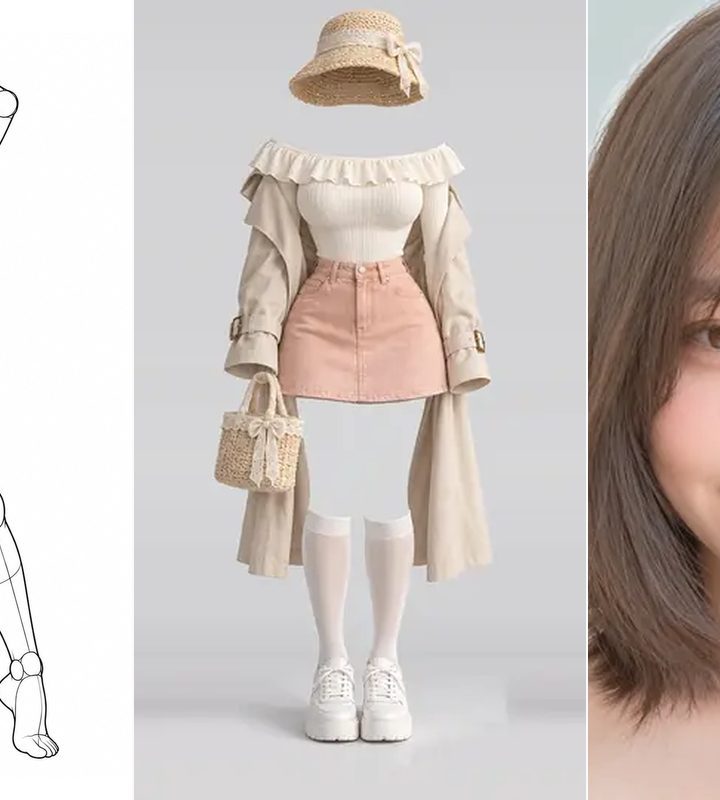
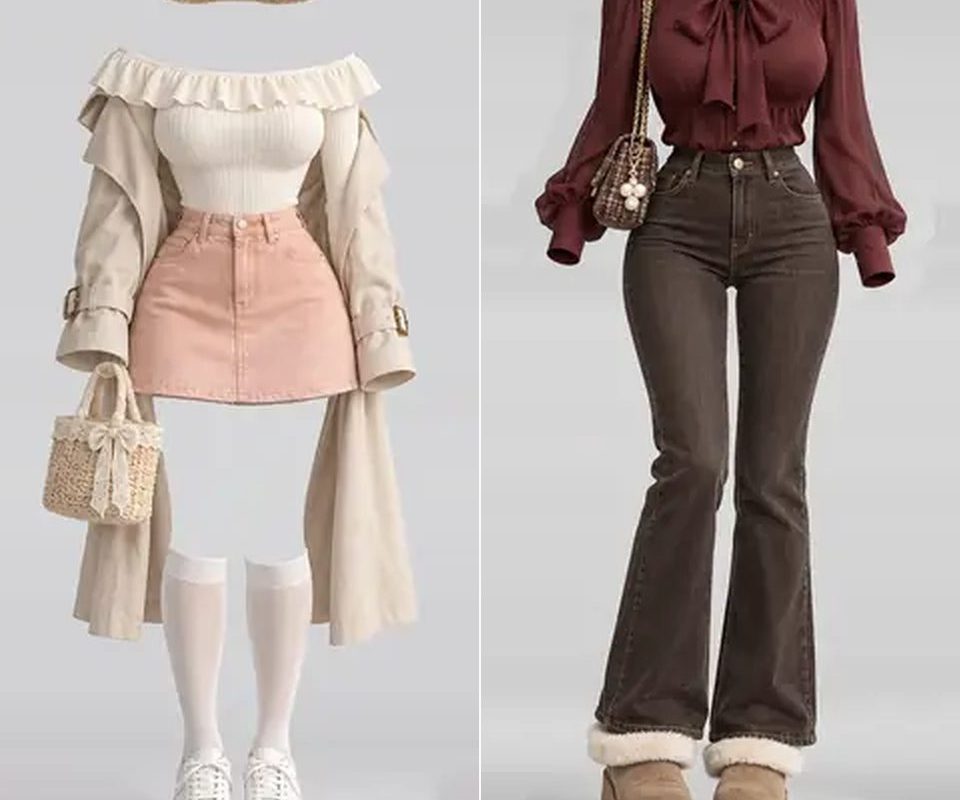
ivory white off-shoulder ruffled knit top, pink corduroy mini skirt, beige long coat draped over shoulders, white knee-high socks, white sneakers, straw hat with ribbon, small woven handbag
This description covers every layer from head to toe, leaving the model almost nothing to guess. That is the whole difference between “accurate” and “roughly right”.
Filter instead of imagining
If you cannot think of a combination, the fastest move is not to force it but to filter in the costume library. The library holds 1,407 outfits organised by season, each broken into 86 tags covering colour, garment, footwear, accessories, material and pattern, and length.
Concretely:
- Fix the direction first with a season or style — spring outfits, for instance.
- Lock the main colour with the colour tags — ivory white.
- Finish with the garment tags — ruffles, knit, skirt.
Every filtered result is itself a written prompt. Copy it, change a few words, and it is ready.
Working with pose and portrait
The outfit description answers “what to wear”, but a full image also needs “how to stand” and “what the face looks like”. Referencing the three dimensions separately is far more effective than mixing them into one sentence:
- Pose → pose library: 288 sets, five angles, depth map and line art
- Outfit → costume library: 1,407 outfits, 86 tags
- Portrait → portrait library: 1,499 references, 51 hairstyles archived by length
The three libraries share one filtering logic. Learn one and you have learned all three.